


#01 - Opening Thought
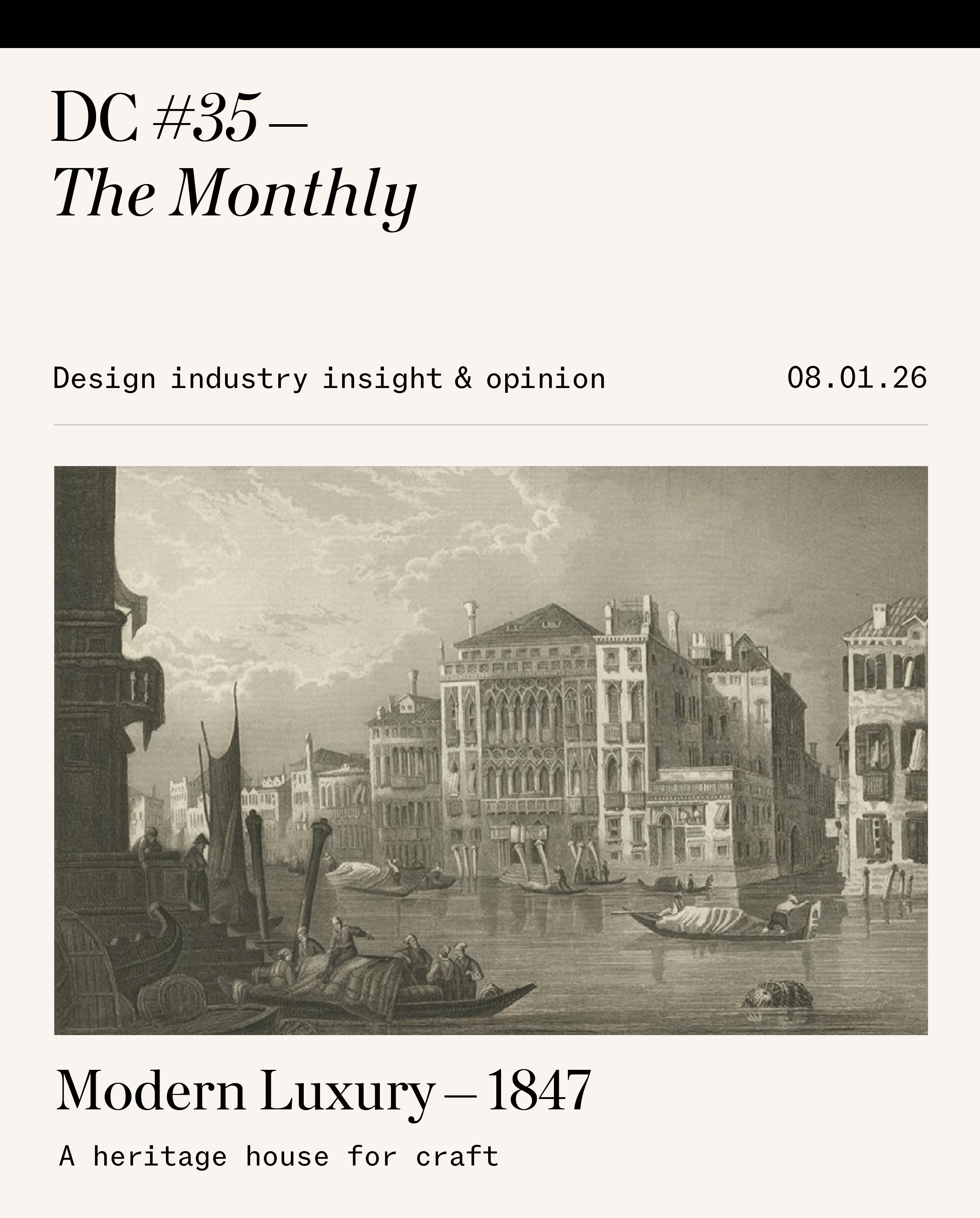
The notion of luxury is evolving, and one of the greatest names in luxury over the last 50 years, Dries Van Noten, has his sights set on what a modern definition for this contentious term should be. Through his Fondazione Dries Van Noten, the retired fashion designer and entrepreneur, with his partner Patrick Vangheluwe, takes that question out of the showroom and into Venice – inside Palazzo Pisani Moretta, the handsome 15th-century palazzo in San Polo (illustrated above in 1847), set directly on the Canal Grande between the Rialto Bridge and Ca’ Foscari.
Opening in April 2026, the Fondazione uses the palazzo as a working setting rather than a runway. The programme spans art, design, fashion, architecture, and dining, bringing established figures and emerging makers into the same rooms, with the expectation that methods, materials, and habits of thinking will travel between disciplines.
Set in a city shaped by commerce, craft, and long memory, the project grounds luxury in practice rather than proclamation. It frames the term as something you can interrogate up close – in skill and time applied well – and positions Van Noten’s next chapter as a considered extension of the values of quality that have always defined his work.
#02 - Screen Grind
Sometimes you need separation to see things more clearly. Taking a proper break in December did it for me. When I came back and picked up where I’d left off, I had to rub my eyes in disbelief at the rubbish I’d been enduring on the screens that I am tethered to for work. Why, for example, did I have a top-of-the-range iPhone (essentially a full-blown pocket cinema) and use it to watch DIY home-video-quality footage of untrained, amateur presenters, mostly talking nonsense about themselves? And why does it make more sense to view it all with the sound off, reading subtitles riddled with typos?
The internet is a mystical space: no sooner had I self-diagnosed that three weeks away from the screen had helped cure a bout of digital brain-rot than I was presented, as if by design, with articles online supporting the theory. The most enlightening was from Christopher Mims in the Wall Street Journal, who calls for 2026 to be the year of “Critical Ignoring” the trash on our feeds. As he writes: “Problems managing our attention in the face of a never-ending media onslaught are so widespread they’ve spawned high-tech remedies, including dumbed-down phones and e-ink gadgets.” We’ve built these unbelievably advanced objects - high-resolution, high-refresh-rate, cinema-grade-screened ‘smart’ devices - yet the media we consume on them is so poor that people are now willingly spending money on worse versions of the same technology. Greyscale smartphones!?
What I’m getting at is this - if you’ve made something in your creative profession that is genuinely good, you still need a medium capable of telling its story properly. Self-promotion - whether you’re making furniture, designing lovely buildings, or physically building houses - is now a key part of your job - and right now, despite the wealth of options to do so, doing it well is tougher than ever. And it will get tougher. The digital space is only going to get more clogged, more synthetic, more hostile to anything real. Sadly, the line between what’s worth your attention and what’s engineered to steal it is disappearing.
What is the right path for the design industry to improve storytelling? Real sources of truth: books, films, properly produced media, events, in-person conversations — maybe even a renaissance of that old classic, the trade fair. And this is where Design Considered fits in: to showcase what’s really worth considering, and what’s worthy of your critical time online.
#03 - Design Selection
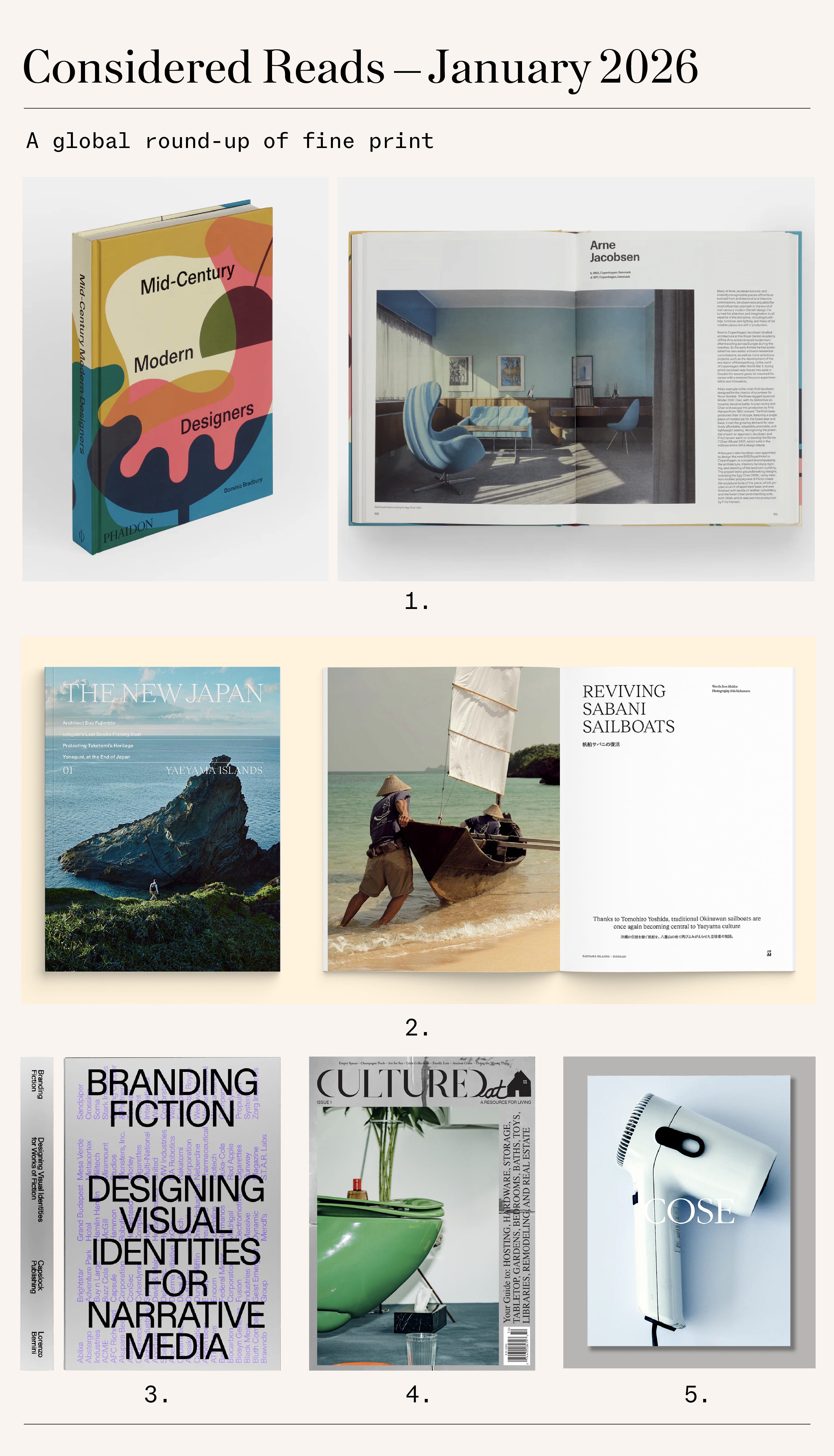
Printed matter is back in 2026, and multiple titles we picked up over the festive break prove this thesis. (1) Mid-Century Modern Designers from Phaidon and written by Dominic Bradbury showcases the works of 300 designers, richly illustrated across furniture, glassware, ceramics, and textiles. It reveals just how global the postwar design conversation was - an era reanimated through objects that still feel startlingly contemporary. For a different sort of reference material, (2) The New Japan is a magazine initiative from NOT A HOTEL — the Japan-based hospitality brand building architect-designed vacation homes. Its printed brand extension makes perfect sense, spotlighting the nation’s exceptional, but overlooked assets to encourage a more sophisticated exploration of Japan for discerning travellers.
Down the rabbit hole of semiotics, (3) Branding Fiction: Designing Visual Identities for Narrative Media beautifully highlights invented logos and made-up packaging. Citing examples like Ted Lasso’s AFC Richmond, this title shows how made-up brands in film, TV, and games achieve their uncanny realism through systems: typography choices, colour logic, brand architecture, and consistency. From US-based Cultured - a magazine spanning contemporary art, design, and architecture - comes (4) Cultured at Home, an annual volume devoted to the rooms, objects, and private rituals that shape contemporary culture. Finally, staying in the magazine world, (5) Cose Journal is a compelling new European title taking a philosophical, image-led approach to the things we handle every day (‘cose’ is Italian for ‘things’).