


#01 - Opening Thought
London may be a hotbed of small businesses, but there’s still something of a stigma here around talking about your venture with unyielding optimism. It’s what makes visiting Nordic nations – and cities like Stockholm – so refreshing, where entrepreneurialism feels culturally encouraged. Here, business confidence comes across as competence, tinged with a Nordic directness that sidesteps American start-up hyperbole. This approach matters most in an industry as tough as European furniture manufacturing – squeezed by tariffs, material sourcing constraints, and a race-to-the-bottom culture of copycatting and quality shortcuts. Last week at Stockholm Creative Edition, it was heartening to hear design-business owners speak optimistically about this industry as a system to be innovated, without compromising quality or heritage.
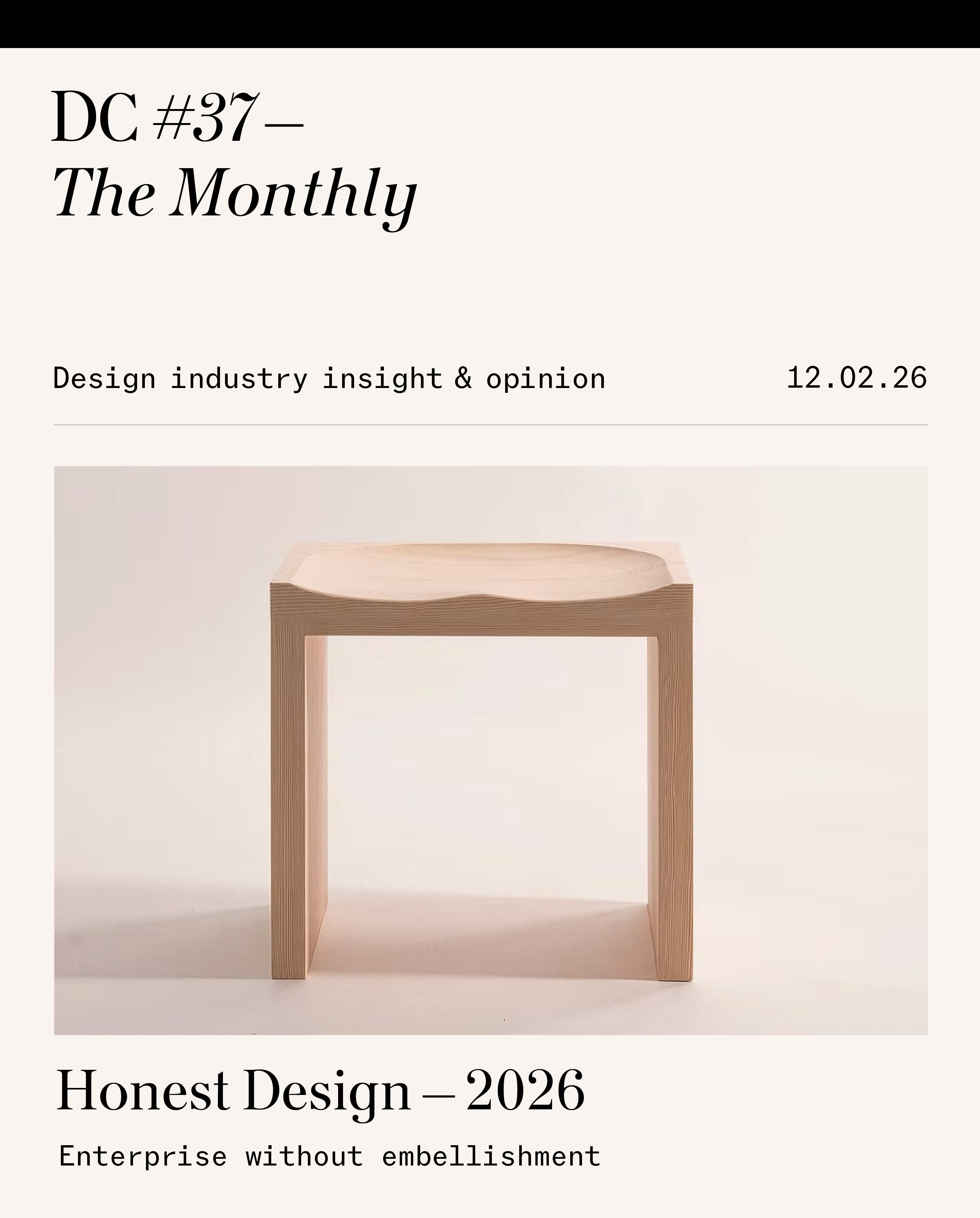
This was the gist of my exchange with entrepreneur Christoffer Söderqvist, founder of EXAKT MFG, who debuted a collection with some pieces designed in collaboration with Superlab. The handsome, minimalist wares (which included the cheekily named Assprint stool, pictured) introduced a brand spun off from his existing manufacturing operation in southern Sweden. Here, he uses the most advanced machinery to keep the business lean and profitable. Yet, despite investing in robotics and engineering, Söderqvist doesn’t sacrifice the past in the pursuit of progress. He explains how, for one sofa, he partnered with an upholstery company in Älmhult – IKEA’s hometown. To refine the piece, the owner had to call in a retired female colleague, dubbed the “upholstery ninja,” who was considered essential to achieving the ultimate result. This is industry best practice – treating craft knowledge as an equal to innovation.
#02 - Feng Shui
We’re about six weeks into 2026, and the word of the year has already emerged. Analogue (or ‘analog’, depending on which side of the Atlantic you sit) has been enlisted to symbolise anything unshackling us from the deluge of AI-generated slop we’re subjected to every day. It’s typically broadcast as a showcase of vintage design, print advertisements, or visual references harkening back to an era when we weren’t glued to screens. This is all a little ironic, of course, as analogue appreciation tends to happen on algorithmically driven feeds on screened devices designed to monetise our attention - but that’s another story for another day.
What I’m keen to unpack is how quickly things come back into vogue. Nostalgia is always such a powerful force in our lives. We’re already deep into a 1990s and early 2000s-style revival (an era with just the right amount of ‘analogue’), and visual feeds are cluttered with imagery inspired by this moment.
A trend I’m seeing in the design space is a moodboard lust for the aesthetically pleasing but functionally awful ‘white slipcovered sofa’ style that stemmed from a late 1990s new-age ‘casual cosy’ era. This was a moment when inspiring interiors were low-key, earthy, and faintly spiritual. While today’s revival leans heavily on taupe palettes and modish minimalism, what’s missing is the thinking that once underpinned the look.
In the 1990s, casual cosiness wasn’t just an aesthetic posture. It was deeply informed by feng shui - an ancient sort of interior design strategy that proliferated across East Asia from China. With its emphasis on harmony, energy flow, and spatial intention, feng shui aligned perfectly with the relaxed ethos of the 1990s in the West, turning slipcovered-couch-laden living rooms into deliberate sanctuaries rather than styled backdrops.
If there’s anything worth resurrecting from the past in 2026, it’s that sense of balance and flow - particularly as global headlines grow bleaker. So instead of wrapping my sofas in soon-to-be-red-wine-stained white sheets, I ordered a copy of Sarah Shurety’s 1997 book Feng Shui For Your Home (how very analogue of me), an illustrated guide to creating ‘a harmonious, happy, and prosperous living environment’.
I’m a good chunk of the way through and, while the numerology element still eludes me, I have learned why beds shouldn’t sit directly in line with doors (in the ‘coffin position’, alluding to how the dead are traditionally carried out of a room). I can now also appreciate how mirrors can either amplify calm or quietly sabotage sleep, and why the kitchen is considered the home’s energetic engine. It’s ancient homemaking wisdom blended with spiritual belief, but much of it feels like practical intelligence shaped over centuries.
The first rule of feng shui is no clutter - which I wholeheartedly endorse. Some ideas I’m less convinced by: the notion that a round house has superior feng shui because there are no corners to trap stagnant energy (alongside the obvious inconvenience of having no flat walls for framed pictures or bookshelves). But there’s a lot of grounded common sense - real fireplaces over artificial heat, pollution-absorbing plants genuinely improve how a space feels, and we should all have a general wariness of microwaves as energy-disrupting, chi-killing, rubbish.
In its essence, feng shui is about attentiveness - to space, to movement, to how environments subtly shape mood. It’s not prescriptive so much as observational, less about achieving perfect harmony than noticing when things feel off. I’m not about to relocate to a round-walled converted lighthouse, but I have doubled down on decluttering and started paying closer attention to where the afternoon sunlight falls. It’s definitely more enriching than scrolling through vintage homewares images on my phone.
#03 - Design Selection
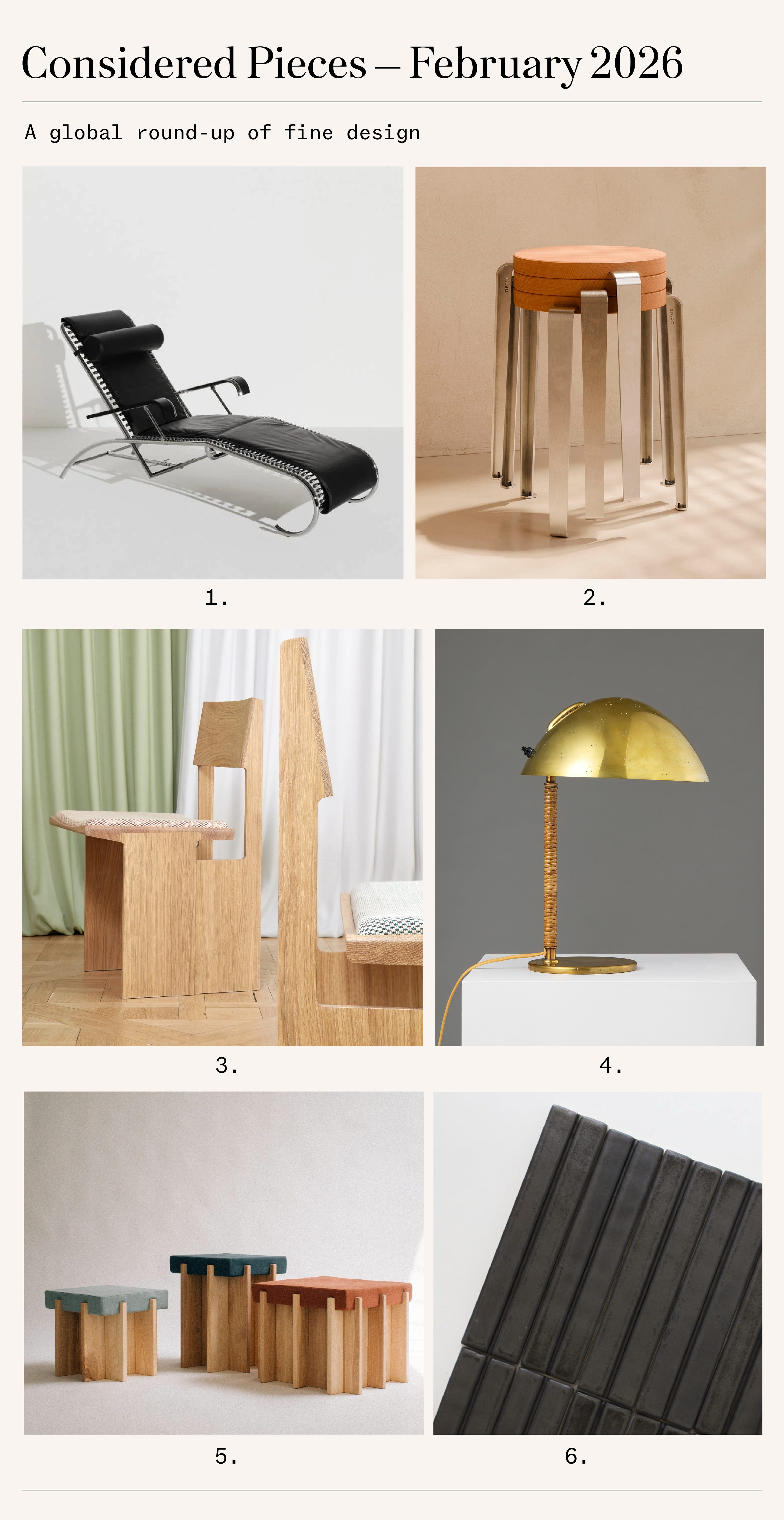
A trio of French releases anchors this week’s edit, beginning with the (1) Sandows Daybed N°114 by René Herbst for Petite Friture (beautiful explainer video here). Unveiled in Paris this January, the re-edition pays homage to the pioneering modernist’s 1927 original - tubular steel and elastic strapping (sandows) that defined French industrial design’s interwar moment. The (2) LOU Stool from Tiptoe distils Gallic pragmatism into a stackable seat that assembles in under a minute. The new CORE edition adds a brushed stainless steel finish to the brand’s signature clamp-on legs, elegantly harmonising industrial utility with chic, covetable design. Rounding out the French contingent is the (3) Drift Chair from Theoreme Editions, designed by Studio BrichetZiegler and pictured in the oak edition. A beautiful creation, its cantilevered seat appears to float above its minimalist frame - a feat of engineering paired with artisan French finishing. It’s available in various timbers with interchangeable fabric or leather cushions.
Moving to Stockholm, vintage purveyor of Nordic design, Modernity (which also has a showroom in London) has a rare (4) Helmet Table Lamp (Model 9209) by Paavo Tynell on the market. Originally produced in 1940 for Finnish manufacturer Taito, the perforated brass shade, nicknamed “Kypärä” (helmet in Finnish), creates a mesmerising starlight-like sparkle through hand-punched triangular patterns. Back in the less elusive realms, (5) Connexion Collection is a easy-self-assemble discovery we missed from 2024 from Milan-based designer YuoNing Chien for 808: Studio. Solid oak half-lap joints create a sturdy grid base that requires no tools or hardware to assemble, and the base is topped with cushions in handwoven ramie, sourced from Chinese artisans. Finally, some fine Mexican tiling from (6) Lofa Ceramics, the Guadalajara-based studio fusing high-temperature techniques with natural glazes to striking effect. Fired at 1,250°C, each tile is made individually using ceramic paste and in-house-formulated glazes made from natural oxides and minerals, yielding colours and textures unavailable through industrial methods.
Analogue is trending. Feng shui next! Thanks Nolan.